Tell rescues Baumgarten across the stormy lake
William TellWilhelm Tell’s rescue of Conrad Baumgarten across the stormy lake is a compact ordeal in which courage becomes a practical choice: Tell takes the boat when the crossing appears perilous and the viceroy’s threat makes delay dangerous. The scene makes his resolve visible in action, then holds its outcome in suspense as the boat disappears among the waves and returns to view with the troopers closing in.
The choice to take the boat
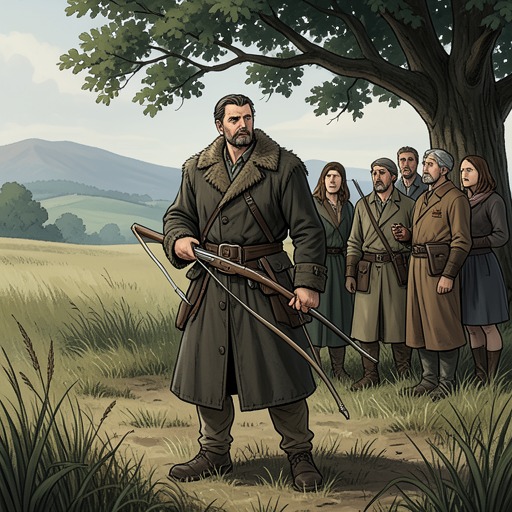
Tell enters carrying a crossbow, and Ruodi identifies him as a brave man from Bürglen. The scene soon sets bravery against the blunt calculation of risk. Tell asks whether he is to plunge into danger and acknowledges that undertaking the crossing could be madness. His response does not deny the peril; instead, he gives his decision a principle: “The brave man thinks upon himself the last.” Trust in God and help for the person in need belong together in his reasoning. The danger remains real, but it does not settle what he ought to do.
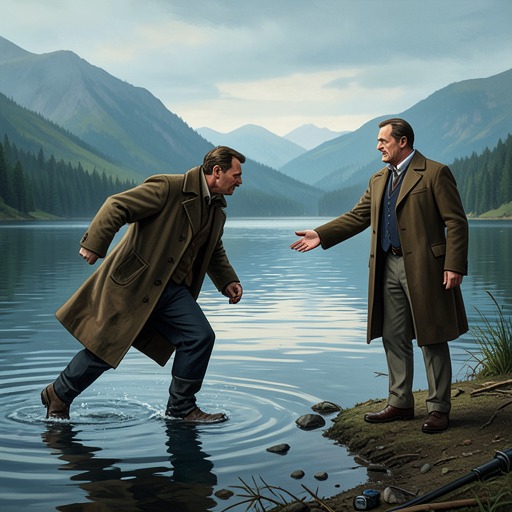
The exchange contrasts advice from safety with responsibility at the water’s edge. One speaker observes that it is easy to advise from a safe harbor, points to the boat and the lake, and challenges the other to try. Tell answers with the scene’s sharpest distinction: “The lake may pity, but the viceroy will not.” The natural danger is unpredictable, but the political threat is presented as deliberate and without mercy. For Baumgarten, waiting is therefore not a neutral alternative to crossing. Tell’s words make the choice a contest between the risk of the storm and the danger posed by the viceroy’s power.
Tell commits himself to the crossing
When the other man refuses, Tell takes responsibility for the boat himself: “In God's name, then, give me the boat! I will / With my poor strength, see what is to be done!” The modest phrase “my poor strength” does not cancel the force of the decision. Tell offers no assurance that he can command the lake; he commits only to making the attempt. The rescue is defined by that distinction between controlling the outcome and accepting responsibility to act.
Tell also recognizes that the crossing exposes him to more than one peril. He says that he may preserve Baumgarten from the viceroy’s power, but another must preserve him from the tempest’s rage. His confidence in undertaking the rescue is therefore not a claim of mastery over the storm. Before embarking, he asks that his wife be consoled should anything befall him and says that he is doing what he cannot leave undone. Those remarks set the possible cost beside the necessity he feels: the danger is personal, but abandoning the effort would itself be intolerable to him.
He then leaps into the boat. That physical action closes the debate over who will go and begins the crossing in earnest. Kuoni remarks on Tell’s fitness as a boatman, while Werni, watching from a rock, calls on God to help him and praises him as a brave sailor. The praise accompanies visible danger rather than an already secured success.
The storm and the watching shore
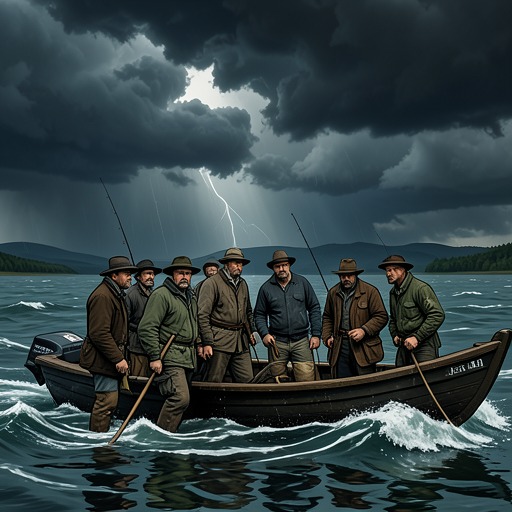
The witnesses follow the boat’s progress in sharply changing glimpses. Kuoni sees the surge sweep clean over it; moments later, it is out of sight. Then it appears again. The sequence does not describe a smooth passage or offer the watchers certainty about Tell’s survival. Instead, disappearance and return become the measure of the crossing: for those on shore, the boat’s presence is repeatedly lost and recovered.
When the boat reappears, Kuoni sees Tell stoutly stemming the breakers and calls him noble. Werni’s earlier cry and Kuoni’s changing observations make the rescue a shared scene of watching as well as Tell’s solitary effort on the water. Their brief exclamations register what they can see, while the waves prevent them from knowing what will happen next. The movement from boat to boatman in their attention keeps the action concrete: first the craft reels, then the surge hides it, then Tell is seen resisting the breakers.
Pursuit and the scene’s stakes
As the crossing continues, Seppi announces that the troopers are coming as fast as they can ride. Their arrival brings the viceroy’s authority into the scene as an immediate pursuit, not merely a danger invoked in conversation. The rescue now unfolds under pressure from both sides: Tell is contending with the storm on the lake while armed men approach along the shore. The play places that approaching force beside the boat’s uncertain progress without yet resolving what the troopers will do or whether they can reach their target.
The episode’s defining contrast is not between fear and fearlessness, but between recognizing danger and allowing danger to excuse inaction. Tell openly names the storm, his limited strength, and the possibility that he may not return; nevertheless, he takes the boat because Baumgarten faces the viceroy’s power. The crossing thus makes courage an obligation enacted at a particular moment. Its suspense rests on the distance between that decision and its outcome: the observers can see the waves, lose sight of the boat, and see it again, while the troopers draw nearer. The rescue’s significance lies in Tell’s choice to enter that uncertainty for another person.